The gaming industry has entered a high-risk area characterized by “existing assets competition + compliance enhancement”. For gaming companies, the equity structure is not merely a one-time transaction at registration—it involves whether risks can be effectively isolated, whether tax burdens are reasonable, whether mergers and acquisitions and exits are smooth, whether capital market integration is feasible, and even whether the founder’s wealth can be safely passed on. At the same time, Article 54 of the new Company Law establishes a system for accelerating the expiration of shareholder contributions. This has reshaped the rights and obligations of creditors, shareholders, and directors, having a profound impact on the capital arrangements of gaming companies.
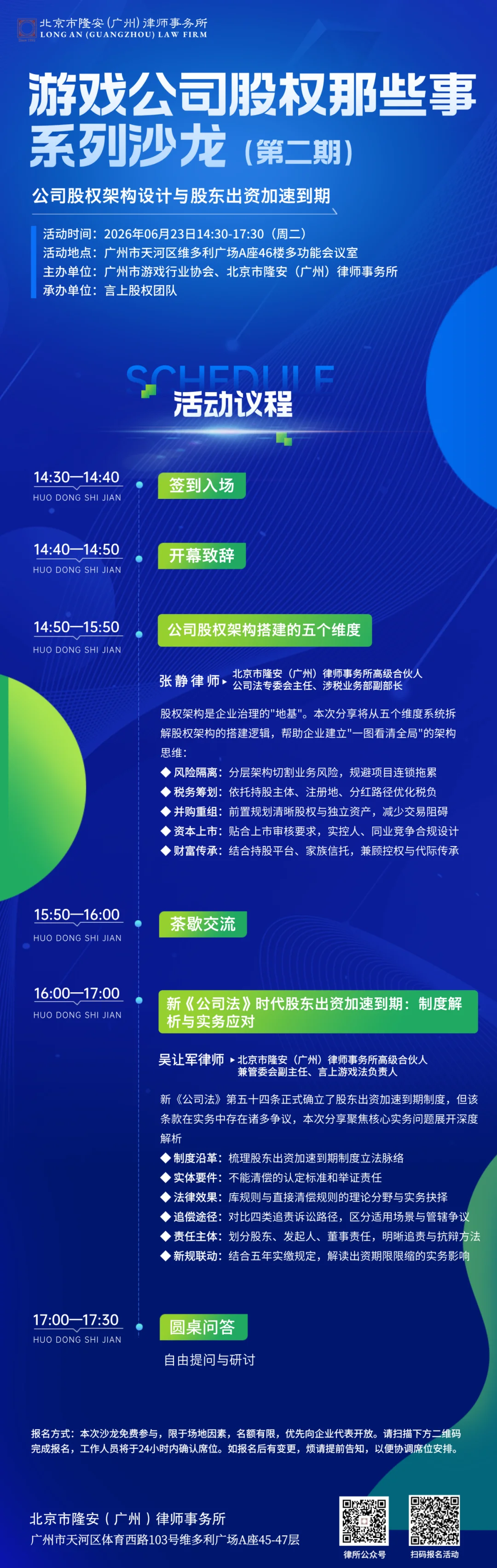
Therefore, the Guangzhou Gaming Industry Association and the Lunan (Guangzhou) Law Firm in Beijing, in collaboration with the Yanshang Equity Team, are organizing the “Issues Related to Gaming Company Equity” series of salons – the second session: “Design of Company Equity Structure and Accelerated Expiration of Shareholder Contributions”. This event continues the practical approach of the first session, with two experienced lawyers who have spent many years in the field of company equity serving as keynote speakers. The focus will be on the systematic methodology for building equity structures in gaming companies, as well as the cutting-edge practical issues related to the accelerated expiration of shareholder contributions in the era of the new Company Law.
All legal and financial officials, corporate shareholders, and management from gaming/Internet companies are welcome to attend and engage in discussions!
Event Information
1. Lecture Theme
“Issues Related to Gaming Company Equity” Series of Salons (Second Session)
“Design of Company Equity Structure and Accelerated Expiration of Shareholder Contributions”
2. Keynote Speaker
 Lawyer Zhang Jing
Senior Partner of Lunan Guangzhou
Director of the Company Law Special Committee, Deputy Director of the Tax-related Business Department
 Lawyer Wu Rangjun
Senior Partner of Lunan Guangzhou and Deputy Director of the Management Committee; Head of Yanshang Gaming Law
3. Time and Date
June 23, 2026 (Tuesday) 14:30 – 17:30
4. Venue
46th Floor, Victoria Plaza, No. 103 Sports West Road, Tianhe District, Guangzhou Lunan (Guangzhou) Law Firm in Beijing
5. Agenda
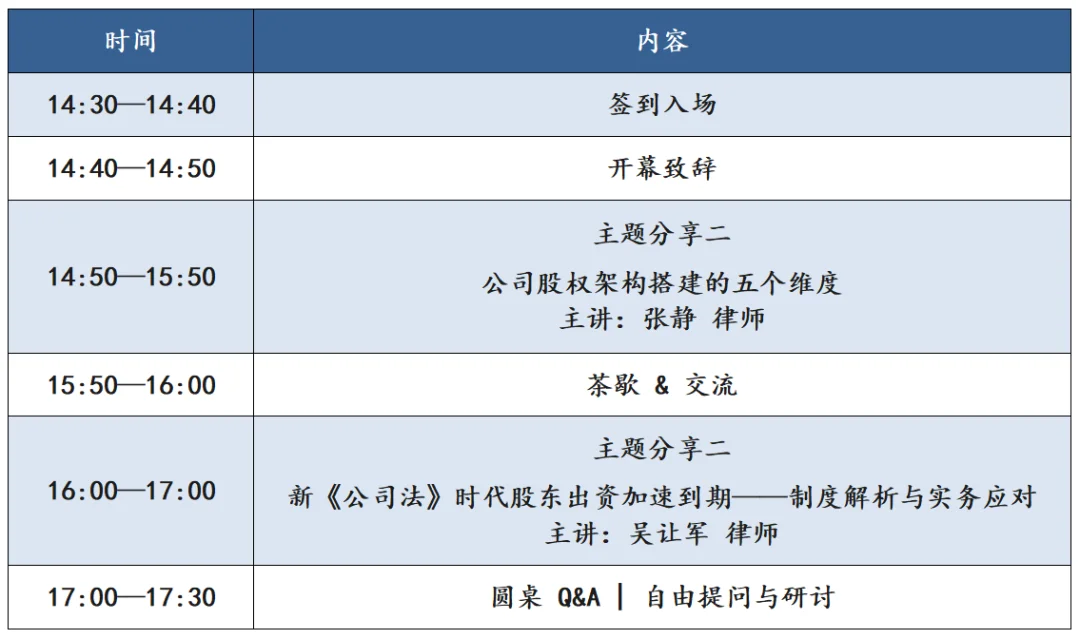 6. Content to be Shared
1. Five Dimensions of Building Company Equity Structure
Speaker: Lawyer Zhang Jing | Senior Partner of Lunan (Guangzhou) Law Firm, Director of the Company Law Special Committee, Deputy Director of the Tax-related Business Department
The equity structure is the “foundation” of corporate governance. This presentation will systematically break down the logic of building equity structures from five dimensions, helping companies establish a “one-picture” understanding of the overall structure:
1. Equity Structure for Risk Isolation: How to achieve risk isolation between different business segments and projects through hierarchical structure design, avoiding a chain reaction where one project issue collapses the entire company.
2. Equity Structure for Tax Optimization: Analyzing the tax planning opportunities in equity structures from perspectives such as shareholding methods (natural persons/partnerships/limited companies), location of registration, and profit distribution paths.
3. Equity Structure for Mergers and Reorganizations: Proactive design for potential mergers or asset reorganizations – clear equity, independent assets, and separable structure to reduce transaction obstacles and compliance risks.
4. Equity Structure for Capital Market Integration: Examining equity structures from the perspective of listing approval: identification of actual controllers, competitive activities in the same industry, related transactions, and clarity of equity – key concerns.
5. Equity Structure for Wealth Inheritance: Design of tools such as family trusts, shareholding platforms, and intergenerational inheritance arrangements within equity structures to achieve both control rights and wealth inheritance.
2. Accelerated Expiration of Shareholder Contributions in the New Company Law Era – System Analysis and Practical Solutions
Speaker: Lawyer Wu Rangjun | Senior Partner of Lunan (Guangzhou) Law Firm, Deputy Director of the Management Committee; Head of Yanshang Gaming Law
Article 54 of the new Company Law officially establishes a system for accelerating the expiration of shareholder contributions in non-bankruptcy and non-dissolution cases, marking a major shift in the creditor protection mechanism. However, this provision faces multiple challenges in judicial practice, including “unclear criteria for determination, doubtful legal effects, ambiguous procedural paths, and complex litigation parties”. This presentation will focus on the following key points:
1. Institutional Evolution: From the exception rules for bankruptcy liquidation to the “exception opening” in the Nine Judicial Opinions, to the legislative establishment of Article 54 of the new Company Law, and to the 2025 Supreme People’s Court’s “Company Law Judicial Interpretation (Draft)” – a complete sequence of institutional evolution.
2. Recourse Paths: A detailed comparison of four procedural paths – step-by-step litigation (first against the company, then against shareholders), enforcement addition (clearly ended in the draft), enforcement objection litigation, and combined litigation (suing both the company and shareholders) – analyzing their advantages and applicable scenarios.
3. Disputes over Legal Effects: The divergence between “storage rules” and “direct payment” in judgments – should creditors only require shareholders to pay contributions to the company (storage), or can they directly demand payment from shareholders (direct payment)? What is the current judicial practice and judicial interpretation draft’s倾向?
4. Litigation Parties: The three-dimensional accountability system established by the new Company Law – the first-order supplementary liability of current shareholders, supplementary liability of previous shareholders and its retroactive issue, the joint capital replenishment liability of promoters, and the compensation liability of directors for failure to fulfill payment obligations… How can creditors maximize accountability, and how can shareholders and directors effectively defend and isolate risks?
5. Impact of the New Five-Year Contribution Rule: How the five-year contribution period established by Article 47 of the new Company Law fundamentally reduces the duration of the contribution period’s benefits and changes the applicable field of the accelerated expiration system?
7. Registration Method
This salon is free to participate in. Due to venue limitations, the number of seats is limited, and priority is given to corporate representatives. Please scan the QR code on the poster below to register, and staff will confirm seats within 24 hours. If there are changes after registration, please inform us in advance so that seat arrangements can be coordinated.