
On March 22, 2024, the “Public Course for Cross-border E-commerce Enterprises” event organized by Longan Guangzhou was successfully held! Lawyer Zhang Jing, a senior partner at Longan Guangzhou, and Lawyer Ke Cheng, a partner, shared their insights on topics related to cross-border e-commerce. Many representatives from cross-border e-commerce enterprises were also invited to participate in this event for exchange and learning. Lawyer Ye Peng, a senior partner at Longan Guangzhou and the head of the Cross-border E-commerce Legal Service Center, served as the host.
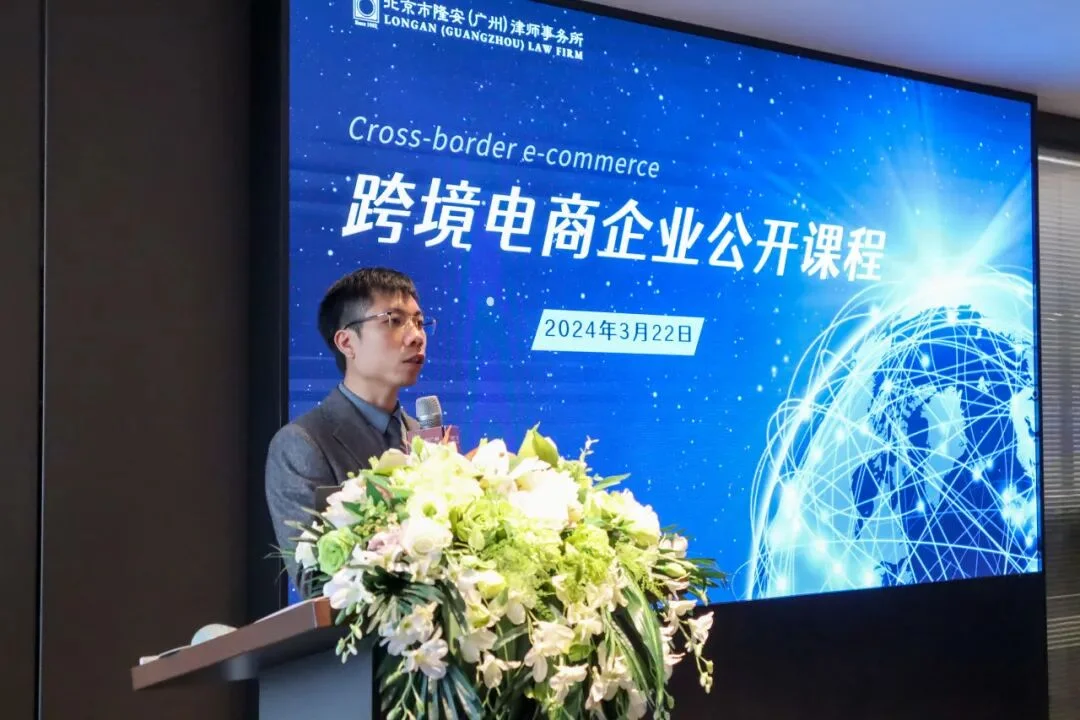 Lawyer Ye Peng
Senior Partner at Longan Guangzhou, Head of the Cross-border E-commerce Legal Service Center
Lawyer Ye Peng explained that with the development of economic globalization, the cross-border e-commerce industry has grown rapidly. As a result, Longan Guangzhou established the Cross-border E-commerce Legal Service Center, aiming to provide comprehensive and high-quality legal services to cross-border e-commerce enterprises, platforms, and participants in payment, storage, and logistics. This event will focus on three main aspects: cross-border e-commerce payment, corporate structure, and the impact of company law on cross-border e-commerce enterprises.
 Lawyer Zhang Jing
Senior Partner at Longan Guangzhou, Director of the Company Law Committee
Lawyer Zhang shared her insights on the theme of “Cross-border E-commerce Foreign Exchange Payments and Corporate Equity Structure”. Starting from several cross-border e-commerce cases, she analyzed the legal risks involved in cross-border e-commerce transactions. She also discussed the conditions for export tax rebates in cross-border e-commerce, the export customs declaration methods (such as 9610, 9710, 9810, and 0110), and how to establish a shareholding structure. Additionally, she explained tax issues related to VAT and consumption tax exemptions for retail exports in cross-border e-commerce. Finally, she analyzed the issue of foreign exchange income returning to the home country from cross-border e-commerce exports from the perspective of foreign exchange compliance. Lawyer Zhang suggested that cross-border e-commerce companies should adhere to basic principles: criminal boundaries must not be crossed, and administrative regulations should be implemented with consideration of risks and costs. It is also necessary to proceed step by step and comply with regulations gradually. Finally, Lawyer Zhang provided specific suggestions for optimizing the trading processes of cross-border e-commerce sellers.
 Lawyer Ke Cheng
Partner at Longan Guangzhou
Lawyer Ke Cheng analyzed the impact of the new Company Law on cross-border e-commerce enterprises. He identified three key points: capital contribution, liability, and protecting minority shareholders. In terms of capital contribution, the new Company Law requires limited companies to pay up their capital contributions within five years. If they fail to do so, they will face legal consequences, including accelerated payment deadlines, loss of rights due to non-payment, and board obligations to collect payments. Based on the requirement of five years for payment and the consequences of non-payment, companies have options such as payment, equity transfer, reduction of capital, and dissolution. The new Company Law introduces new rules regarding payment methods, equity transfer, reduction of capital, and dissolution. In terms of liability, the new Company Law strengthens the responsibilities of directors, including liability for harming the interests of shareholders, the company, and creditors. There are also provisions for liability for illegal distribution of profits, illegal financial assistance, and other responsibilities of directors and executives. In terms of protecting minority shareholders, the new Company Law significantly adjusts the rights of shareholders to know and request equity transfers, providing greater protection for minority shareholders. Finally, regarding the issue of five-year payment requirements for registered capital in cross-border e-commerce enterprises, Lawyer Ke Cheng explained the regulations regarding the registered capital registration system (draft) and the options available to cross-border enterprises, as well as the associated risks.


 This “Public Course for Cross-border E-commerce Enterprises” event was organized by the Longan Guangzhou Cross-border E-commerce Legal Service Center. It is important for promoting compliance in export transactions, establishing proper equity structures, and understanding changes in the legal environment. In the future, the Longan Guangzhou Cross-border E-commerce Legal Service Center will organize more events related to customs clearance, data exports, and criminal compliance, to ensure the healthy development of cross-border e-commerce enterprises.