
Preface:
In recent years, cases of frozen goods smuggling have occurred frequently. Many of the frozen meat products involved in these cases have not passed inspection and quarantine procedures. Some are even “dead meat” that has been stored for many years, coming from areas where animal diseases are prevalent, carrying a large number of pathogenic bacteria. However, frozen goods smuggled in often show no obvious difference in appearance from normal food ingredients, making it difficult for ordinary consumers to distinguish them. To prevent the harm to public food safety caused by smuggled frozen goods, major functional departments such as customs and market supervision have always maintained strict measures against such smuggling activities.
This article discusses the conviction and sentencing issues related to frozen goods smuggling, based on a recent case of frozen goods smuggling resolved by our team.
Brief Summary of the Case:
Starting from the second half of 2021, individuals such as H ordered frozen beef, frozen pork, and frozen chicken feet from foreign suppliers like X, and these goods were smuggled into China through bypassing customs. Then, individuals like L and M disassembled the smuggled goods from ordinary trucks into refrigerated trucks at a warehouse in Guangzhou, transferring them to other locations. More than 40 tons of smuggled frozen goods were seized at the scene, with the total value of the goods involved exceeding 1.1 million yuan.
This is a very typical case of frozen goods smuggling through bypassing customs. Through our team’s defense, the amount involved was significantly reduced, avoiding a more severe sentence.
1. Overview of Smuggled Frozen Goods
Using keywords such as “frozen goods” and “frozen meat,” our team searched for criminal judgment documents related to smuggling crimes in the past 5 years (as of May 1, 2025) using tools like Alpha and Weike. After removing some irrelevant data, 449 cases were identified. The publicly available online data is not complete, but this number is still alarming.
Personnel Involved in the Case
Smuggling crimes are chain-based crimes involving many people. This includes foreign suppliers, customs-bypass gangs, domestic buyers, domestic owners, agents, wholesalers, and water carriers. Based on the cases we reviewed, most of the individuals involved were domestic owners, agents, or wholesalers. As a result, many were considered accomplices (410 people).
Sentence Distribution
As mentioned earlier, since smuggling cases often involve many people, sentences (especially primary sentences) are based on individuals. The total number does not match the number of cases.
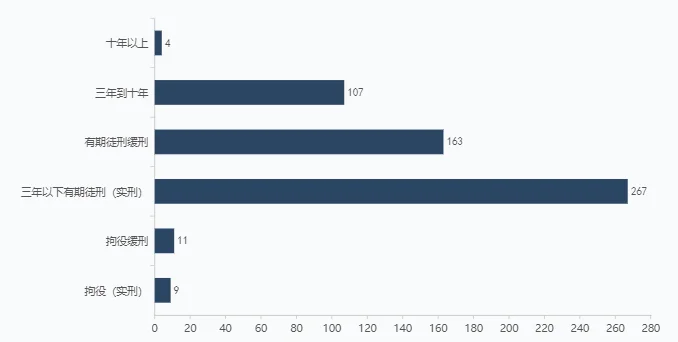 Primary sentences for frozen goods smuggling (Alpha search data)
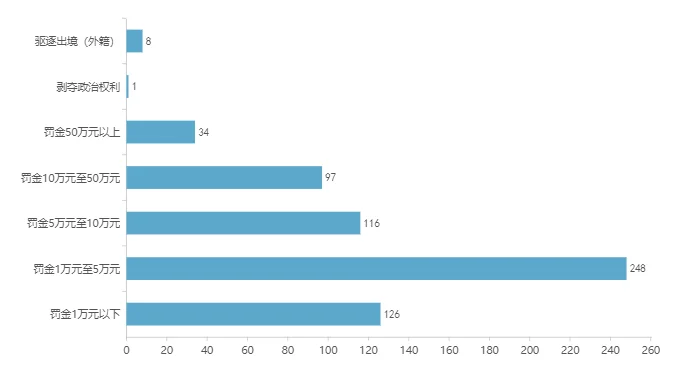 Additional sentences for frozen goods smuggling (Alpha search data)
Areas Where Frozen Goods Smuggling Is Common
From the chart, it is clear that the Guangdong and Guangxi regions have the highest numbers, with over 180+ cases! Followed by Yunnan (63), Zhejiang (45), Shanghai (30), and Fujian (20). There is a significant trend in the southeastern and southwestern coastal areas.
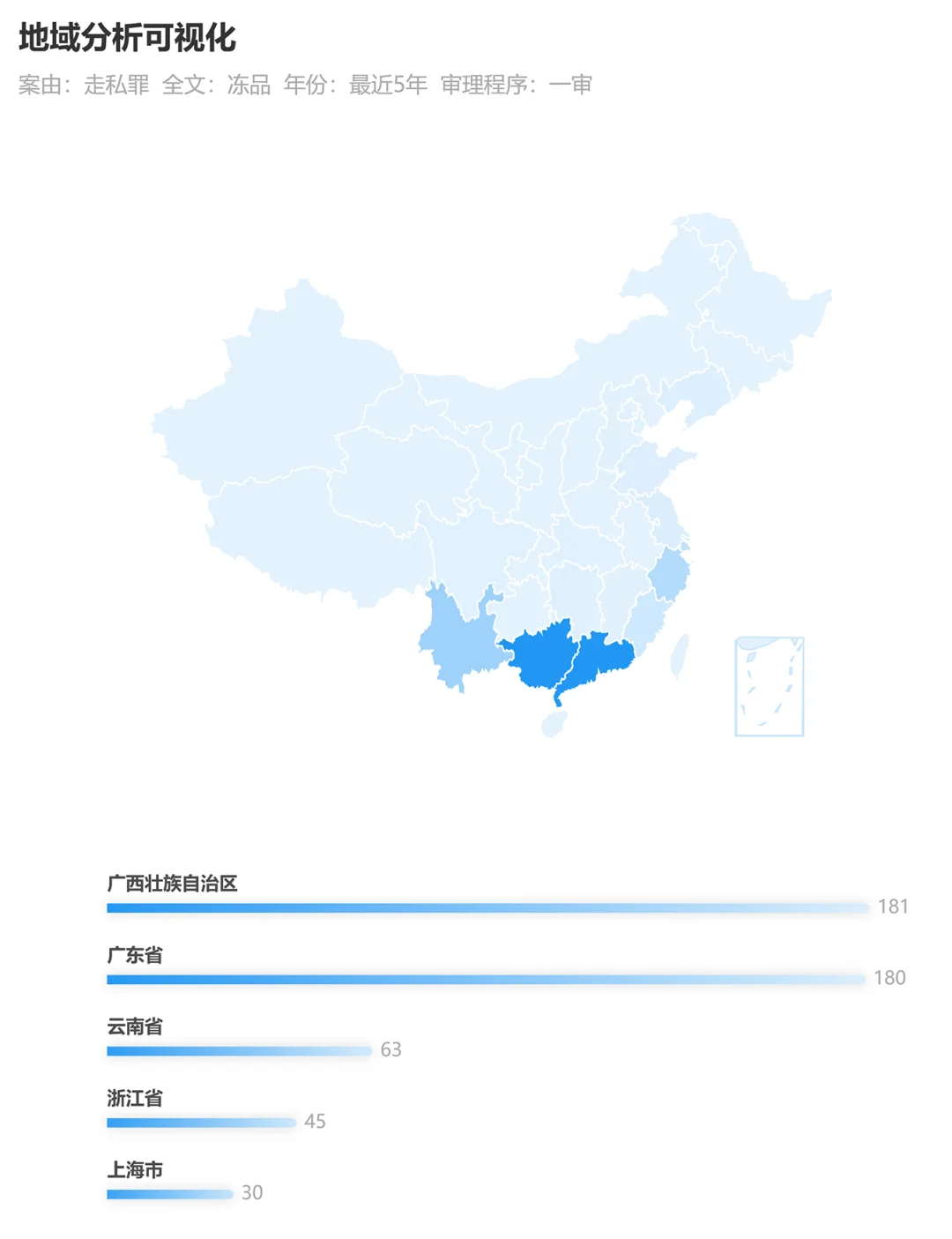 Distribution map of frozen goods smuggling cases in the past 5 years (Alpha search data)
In practice, frozen goods smuggling in coastal and border areas takes different forms, but they share similar principles: the southeastern coast uses large motorized boats to smuggle goods into small ports and wild ports, then distributes them across the country through domestic delivery and truck transport. In the southwestern border areas, goods are smuggled through the geographical proximity with Vietnam, without passing through ports, using vehicles for transportation.
2. Crimes Involved in Frozen Goods Smuggling
Generally, frozen goods smuggling may involve three types of crimes. Based on the search data: 388 cases related to smuggling goods and items prohibited by the state, 58 cases related to smuggling ordinary goods and items, and 3 cases related to smuggling precious animals and their products.
If the smuggled goods include precious animals (products), it may involve the crime of smuggling precious animals (products). The sentencing range is three levels: up to 5 years in prison, and even life imprisonment, along with confiscation of property.
_
General Behavior
If no animals die, or the animals and their products cannot be recovered, and the perpetrator fully returns the stolen goods and compensates, showing genuine remorse:
① If the person is a leader of a criminal group; ② If they use special vehicles to avoid supervision; ③ If they have been given administrative penalties for destroying wildlife resources within two years.
— heavier punishment!
Value: 20,000–200,000 yuan
Up to 5 years in prison, plus a fine.
No prosecution or reduced criminal punishment is possible.
If the circumstances are minor and not harmful, it is not considered a crime.
Value: 200,000–2 million yuan
5 to 10 years in prison, plus a fine.
5 years or less, plus a fine.
Value: Over 2 million yuan
Over 10 years or life imprisonment, plus confiscation of property.
5 to 10 years in prison, plus a fine.
Sentencing standards for smuggling precious animals and their products
If there are no precious wild animals (products) involved, the above crimes do not apply. In this case, since the smuggled frozen goods are ordinary frozen meat products (like pork, beef, chicken), it is usually the crime of smuggling ordinary goods and items, or the crime of smuggling goods and items prohibited by the state.
The crime of smuggling ordinary goods and items is mainly based on the tax evasion amount. The crime of smuggling goods and items prohibited by the state is based on the weight or amount of the goods. This difference affects the severity of the crime in each case of frozen goods smuggling, sometimes making it a crime, sometimes not.
_
3 years or less
3–10 years
Over 10 years or life imprisonment
Crime of smuggling ordinary goods and items
Tax amount: 1–50,000 yuan (individuals); 2–100,000 yuan (enterprises)
Tax amount: 50–250,000 yuan (individuals); 100–500,000 yuan (enterprises)
Tax amount: Over 250,000 yuan (individuals); over 500,000 yuan (enterprises)
Sentencing standards for the crime of smuggling ordinary goods and items
_
_
5 years or less
Over 5 years
Crime of smuggling goods and items prohibited by the state
From epidemic areas
Weight standard: 5–25 tons (excluding 25 tons)
Amount standard: 5–25,000 yuan (excluding 25,000 yuan)
Weight standard: Over 25 tons
Amount standard: Over 25,000 yuan
From non-epidemic areas
Weight standard: 20–100 tons (excluding 100 tons)
Amount standard: 20–100,000 yuan (excluding 100,000 yuan)
Amount standard: Over 100 tons
Amount standard: Over 100,000 yuan
Sentencing standards for the crime of smuggling goods and items prohibited by the state
In general, there are significant differences in the standards for determining whether frozen goods involved in a case are “precious animals (products)” and the severity of the crime. In other words, the crime of smuggling precious animals (products) is more severe than the other two crimes.
Note:
① “Precious animals” refer to national first- and second-class protected animals listed in the “National Key Protected Wildlife List,” as well as wildlife listed in Appendix I and Appendix II of the “Convention on International Trade in Endangered Species of Wild Fauna and Flora.”
② On April 9, 2022, the Supreme People’s Court and Supreme People’s Procuratorate issued guidelines on interpreting relevant laws in cases of crimes related to destroying wildlife resources. It was clearly stated that if the animals involved are artificially bred, and certain conditions are met, they are not considered crimes. If criminal responsibility is required, a lenient approach should be taken according to law.
3. Selection of Crimes
Both cases involve frozen goods smuggling. So, when is it considered the crime of smuggling ordinary goods and items, and when is it the crime of smuggling goods and items prohibited by the state? In practice, the selection of crimes depends on two factors: whether the frozen goods come from “epidemic areas” (countries with animal diseases), and whether they have passed “inspection and quarantine.”
① If the frozen meat comes from epidemic areas, it is very likely to be considered the crime of smuggling goods and items prohibited by the state.
To determine whether the frozen goods come from epidemic areas, you can refer to the website of the General Administration of Customs, “List of Animals and Their Products Prohibited from Importing from Countries with Animal Diseases.” As of this article’s publication, the latest version is from June 9, 2025.
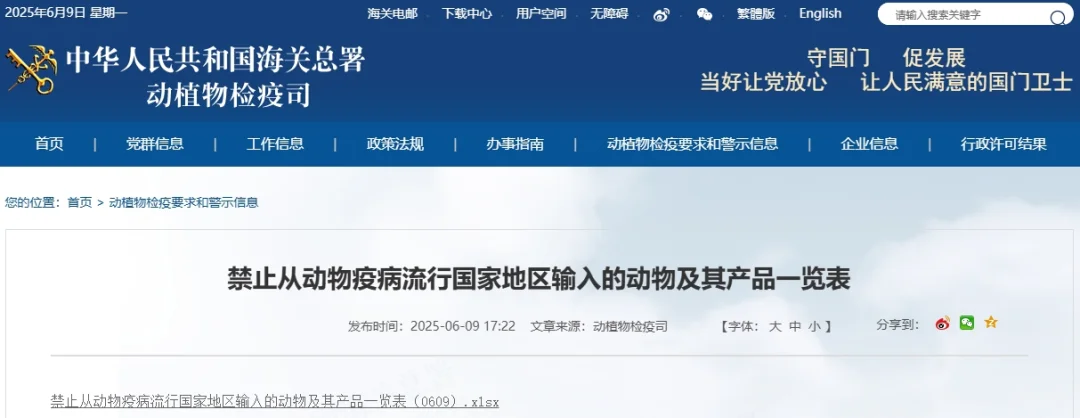 Source: General Administration of Customs, Animal and Plant Quarantine Department http://dzs.customs.gov.cn/dzs/2746776/2753557/index.html
② If the frozen goods come from non-epidemic areas, it depends on whether they are listed in the “List of Countries and Regions That Meet the Requirements for Importing Meat Products into China” and whether they have passed inspection and quarantine procedures in China.
a. If they have passed inspection and quarantine procedures, the crime of smuggling ordinary goods and items is usually applied.
b. If they have not passed inspection and quarantine procedures, such as smuggling through bypassing customs, then you need to refer to the “List of Countries and Regions That Meet the Requirements for Importing Meat Products into China” published by the General Administration of Customs. If they are not on the list, it is very likely that they are considered the crime of smuggling goods and items prohibited by the state.
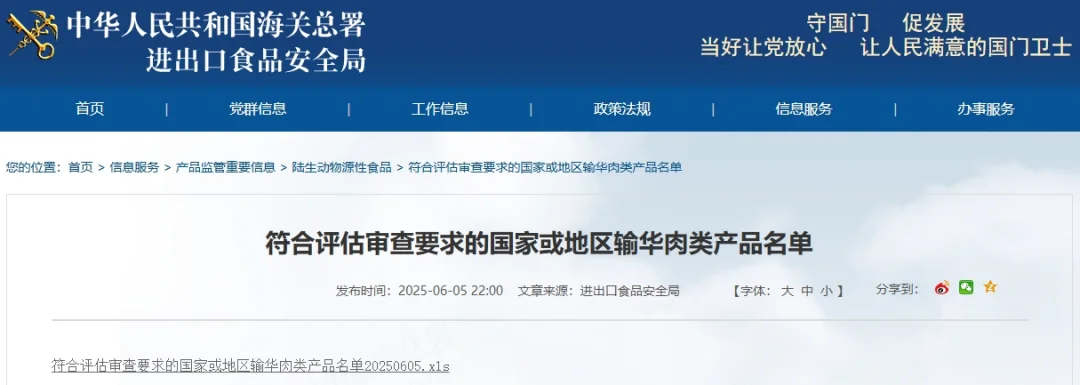 Source: General Administration of Customs, Import and Export Food Safety Bureau http://jckspj.customs.gov.cn/spj/xxfw39/cpjgzyxx/lsdwyxsp/fhpgscyqdgjhdqshrlcpmd/6032333/index.html
In the above case, the defense team suggested that the goods involved should be distinguished as whether they come from epidemic areas, and a detailed classification table was created. Eventually, the prosecution accepted the defense, and the sentence was reduced, avoiding a more severe punishment (over 5 years).
4. Handling of Unknown Origin
If it is impossible to determine the origin of the frozen goods involved, they should be considered as coming from “non-epidemic areas.”
① According to the “Guiding Opinions on Several Legal Issues Concerning the Handling of Cross-border Smuggling Crimes in Guangdong-Hong Kong-Macao Region” issued by the Supreme People’s Court, Supreme People’s Procuratorate, General Administration of Customs, Ministry of Public Security, and China Coast Guard (Document No. 141, 2021), frozen goods whose origin cannot be determined are considered as coming from non-epidemic areas. Their quantity or amount is calculated based on the appropriate rate.
② This rule applies to cross-border smuggling in the Guangdong-Hong Kong-Macao region. What about outside this region, in non-crossing smuggling situations? In my opinion, compared to epidemic areas, the standards for criminalizing and punishing frozen goods smuggling in non-epidemic areas are higher. According to the principle of “benefiting the suspect or defendant,” frozen goods smuggling outside the Guangdong-Hong Kong-Macao region or in non-crossing situations should also be treated as products from non-epidemic areas.
For example, in this case, some frozen chicken feet (7,426KG) and frozen beef (11,009KG) had unknown origins. Therefore, the defense team suggested that these goods should be considered as coming from non-epidemic areas. Since the total weight and amount of these goods did not reach the threshold for criminalization, they should not be counted in the prosecution’s case. Eventually, the prosecution accepted the defense, and these goods were excluded from the case.
5. Application of Tax Rates
If the case is considered the crime of smuggling ordinary goods and items, the key issue is the application of tax rates. In practice, different smuggling methods result in different tax rate applications.
(1) Customs smuggling: The lowest rate is applied among the most-favored nation rate, agreed-rate, and preferential-rate.
The applicable tax rate should be based on the “Customs Law of the People’s Republic of China” and the “Methods for Calculating Tax Evasion Amounts for Goods and Items Smuggled” and other regulations.
a. If the origin of the goods meets the conditions for the most-favored nation rate, agreed-rate, or preferential-rate, the tax amount should be calculated based on the appropriate rate.
b. If the origin of the goods cannot be determined, the most-favored nation rate is applied.
(2) Bypassing customs (non-customs area smuggling): Ordinary rate.
The “Minutes of the Special Seminar on Handling Smuggling of Refined Oil in Non-customs Areas” issued by the Supreme People’s Court, Supreme People’s Procuratorate, General Administration of Customs (Document No. 210, 2019) clearly states: “The tax evasion amount for criminal cases of smuggling refined oil in non-customs areas should be calculated using the ordinary rate, and the most-favored nation rate or provisional rate should not be applied.” For other goods besides refined oil, the “Minutes” also state: “Related issues regarding criminal cases of smuggling sugar and frozen goods in non-customs areas can be handled according to the spirit of these minutes.”
Although these “Minutes” are often criticized by legal scholars, in practice, many courts still apply the ordinary rate for criminal cases of frozen goods smuggling in non-customs areas. Compared to the most-favored nation rate, agreed-rate, and preferential-rate, the ordinary rate is much higher. For example, for frozen chicken feet (tax code 0207142200), the most-favored nation rate is 1 yuan per kilogram, while the ordinary rate is 3.2 yuan per kilogram. For frozen beef (tax code 0202300090), the most-favored nation rate is 12%, while the ordinary rate is 70%!
In this case, since the crime is the crime of smuggling goods and items prohibited by the state, there is no issue with tax rates. If the case were considered the crime of smuggling ordinary goods, based on rough calculations by the team, the base sentence would likely be between 3 and 10 years, significantly increasing the sentence for the defendant.
6. Other Crimes May Be Involved After Frozen Goods Are Smuggled into China
If frozen meat is smuggled without inspection and quarantine, it may carry many harmful bacteria and viruses, posing a serious threat to public health and posing a major food safety risk. It should be noted that importing frozen goods involves not only smuggling crimes, but also other crimes in the domestic sales and distribution process. Common crimes include:
(1) Crime of producing and selling toxic and harmful food.
In March 2019, defendant Xie opened a DW frozen goods store in Baoshan District, selling frozen beef. During this period, he bought imported beef without inspection and quarantine certificates and sold them to make profit. On October 1, 2019, the police arrested Xie and seized 1,187.7 kilograms of beef without inspection and quarantine certificates. Testing showed that 710 kilograms of beef contained clenbuterol. Xie was sentenced to 7 months in prison and fined 20,000 yuan. He also had his illegal profits confiscated, and the toxic and harmful food and his personal property were confiscated. [(2019)沪7101刑初595号]
In this case, the court convicted Xie of selling imported frozen beef containing clenbuterol because he could not provide inspection and quarantine certificates, but there was no evidence proving his involvement in the smuggling process. Therefore, he was convicted of the crime of selling toxic and harmful food.
(2) Crime of producing and selling food that does not meet safety standards.
In June 2016, defendants Hou and others hired Du and Wang to be captains and crew members. They used a ship to transport goods to the open sea, without any customs or inspection procedures. They bought frozen goods from large ships and loaded them at B and X docks in Cangnan County, then transported them using refrigerated trucks to other places for sale. On February 20, 2017, during the unloading process at X dock, they were caught by the police. They were seized 4332 boxes of frozen American chicken feet, Brazilian chicken feet, and Polish pork head meat, totaling 68.6 tons, with a value of 520,721 yuan. After first and second-instance trials, the defendants were sentenced to 1 year and 6 months to 4 years and 6 months in prison. [(2019)浙03刑终567号]
In this case, since the frozen goods involved were products from areas where animal diseases were prohibited by the state, Hou and others’ actions of buying, bypassing customs, and selling in China constituted both smuggling and food safety crimes. The crime with the heavier penalty was chosen: the crime of producing and selling food that does not meet safety standards.
(3) Crime of producing and selling fake and shoddy products.
In May 2014, defendant Zhao worked with Zhang to operate DD aquatic products in Putuo District, Shanghai. They sold 68 boxes, totaling 2,294.72 kilograms, of imported IBP beef from others at a price of 191,609.12 yuan to HU and Zhuo’s RA restaurant. The IBP beef seized did not contain clenbuterol. Zhao was sentenced to 10 months in prison, suspended for 1 year, and fined 100,000 yuan. The seized IBP beef was confiscated. [(2015)温鹿刑初字第515号]
Producing and selling food that does not meet safety standards, without evidence of causing serious food poisoning or other serious food safety issues, does not constitute the crime of producing and selling food that does not meet safety standards. However, it constitutes other crimes such as producing and selling fake and shoddy products. In this case, no toxic substances were detected, so it was convicted of the crime of producing and selling fake and shoddy products.
Conclusion:
When those who smuggle imported frozen goods sell them again, they may be convicted of both smuggling and food safety crimes. However, since their actions are related, usually only the more serious crime is chosen.
Lawyer’s Reminder: The penalties for smuggling crimes are already very severe, and the penalties for food safety crimes are even more severe. For example, the highest sentences for the three food safety crimes are life imprisonment and death! In addition to import operators, domestic agents, wholesalers, and restaurants must also operate legally and honestly, and should not buy or use smuggled frozen goods for profit.
If businesses or individuals are involved in a frozen goods case, first, do not take chances by fabricating facts or hiding the truth to avoid administrative or judicial authorities. Second, they should consult professional customs lawyers and criminal defense lawyers