
In the Sora era, how can legal professionals avoid being replaced by AI? Recently, several lawyers from Longan (Guangzhou) Law Firm in Beijing provided their answer. The book “Guide to the Application of ChatGPT for Legal Professionals,” written by lawyers from the Longan Bay Artificial Intelligence Law Research Center and Tang Jianjie, has been officially published. The book provides an in-depth analysis of the above issues.
Quick Overview of Key Points:
- AI for legal professionals: unemployment or opportunity?
- Why should legal professionals learn AI?
- Is AI difficult? How can legal professionals start learning AI from scratch?
- In the AI era, what abilities should legal professionals develop more?
- Conclusion: It’s better to stay at home and plant trees than fear standing by the water’s edge
AI for legal professionals: unemployment or opportunity?
The development speed of AI is really fast, fast enough that everyone is worried it will take away their jobs.
In April 2023, a Stanford female doctor founded Pika, an AI video tool, which caused a frenzy in the capital market. In half a year, it received $55 million in financing, and unexpectedly, it also boosted the stock price of her father’s company in China—Xinyada.
In less than a year, OpenAI released Sora on the sixth day of the first month of the Year of the Dragon, causing excitement and panic in the technology world. Excitement is that the quality of Sora’s text-to-video output is excellent; for ordinary people, it can fulfill the “dream of making movies,” and for film and television workers, it greatly increases productivity. Panic is that Sora acts like a physical world simulator, learning physical laws in the real world through videos (such as apples falling to the ground when ripe, fire boiling water, etc.). It can “continue” videos, and with sufficient computing power, continuing videos becomes predicting the future, completely breaking the boundary between the digital world and the real world.
All industries are destined to be reshaped by AI again, and the legal industry is no exception.
GPT first challenged the American bar exam, and candidates consistently failed to achieve an average score. Until GPT-3.5 passed the exam and more than 10% of candidates scored above average, then it took less than 6 months to upgrade to GPT-4, which defeated more than 90% of candidates this time.
While legal professionals are worried about AI taking their jobs, capital has already started to develop the AI legal market: LexisNexis announced the world’s first generative AI platform for the legal industry called Lexis+ AI™. The generative robot fleeAI jointly developed by Microsoft and international law firm DENTONS (a former partner of Dalian Cheng & Co in China) and HarveyAI, which received $80 million in funding, has cooperation with industry leader Allen & Overy. It is said that 15,000 law firms are waiting to use this product.
What is more notable is that domestic judicial authorities are also creating their own artificial intelligence case handling systems.
In January 2024, the Suzhou Intermediate Court introduced a generative artificial intelligence-assisted case handling system that can generate legal documents based on a judge’s thinking. The accuracy is said to be over 95%, and the completeness of the judgment documents is 70%.
Additionally, according to the “Procuratorial Daily” in November 2023, the Supreme People’s Procuratorate carried out a pilot project of an intelligent-assisted case handling system for criminal trials in 9 procuratorates across the country, achieving significant results.
It is clear that whether in the technology, capital, or judicial fields, there is an unprecedented consensus: artificial intelligence is an inevitable trend. None of us can stay out of it, and legal professionals are no exception.
Why should legal professionals learn AI?
Not long ago, a university criminology teacher told the author: Using GPT has changed my outlook on life. He tried to ask his assistant to send a paper outline to ChatGPT, and unexpectedly, ChatGPT generated content that matched 80% of his expectations in less than a minute, greatly touching this experienced legal professional: The knowledge that has taken years of study and a lifetime to acquire can now be consumed by GPT in one go. Therefore, he, who hardly uses the Internet, suddenly decided to learn how to use ChatGPT.
Each legal professional has different reasons for starting to learn AI. University teachers and students want to improve the efficiency of writing papers, lawyers want to generate batch of legal documents with one click, judges expect AI to assist in writing judgment documents, prosecutors hope AI can help with intelligent sentencing, and public security officers might think: If criminals use ChatGPT, we should also keep up with the times and know our opponents.
Since the popularity of ChatGPT, there are many tutorials on using ChatGPT, but few related to the legal industry. If legal professionals want to learn how to use ChatGPT in legal contexts, there is a lack of systematic references. Fortunately, the authors are all legal professionals with certain technical skills and some background in engineering. Therefore, in our practice using ChatGPT, we know very well “what ChatGPT can do,” and even better, “what ChatGPT can help legal professionals do.” This motivated the authors to spend a year last year writing this book “Guide to the Application of ChatGPT for Legal Professionals,” aiming to effectively help some legal professionals use ChatGPT first and learn to use AI to solve daily legal problems.
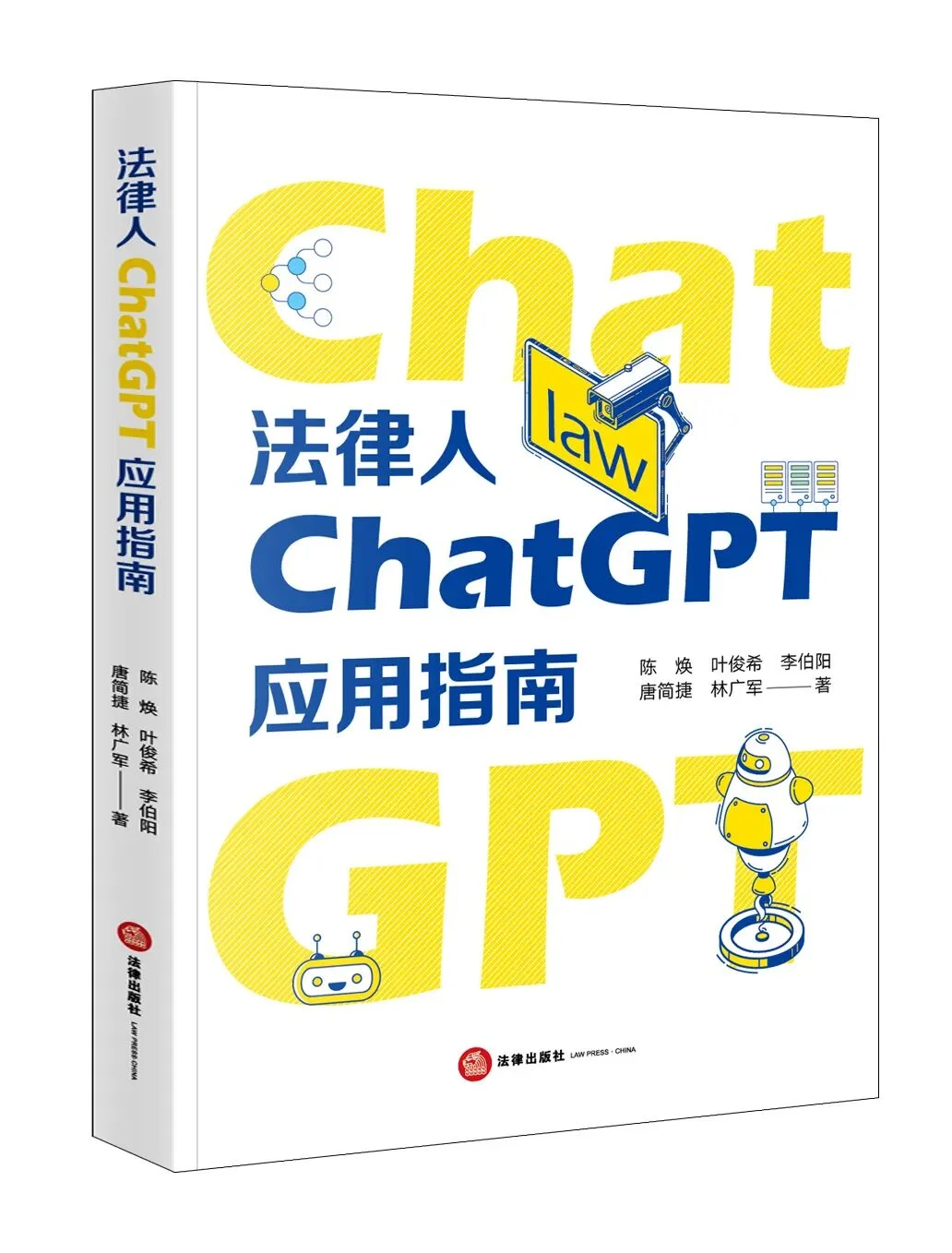
There is another reason for writing this book: As young legal professionals, we are indeed “competed” by AI, which also gives us a strong sense of concern—after legal professionals start families and have children, they often face pressures related to health, family, and relationships, and cannot devote 100% of their energy to work, let alone learning new things. Youth is the capital for learning. If we seize the opportunity to learn AI before this important life transition, it is an opportunity to overtake the competition in the market or workplace. If we miss this opportunity, we cannot establish a unique advantage in market/employment competition, resulting in an awkward development bottleneck:
Looking at the previous waves means that older professionals who gained a first-mover advantage by waiting in line, obtaining resources, and maintaining a dominant position will have little share, while lawyers who fall behind will have difficulty getting promoted; looking at the next waves refers to strong young case handlers and business experts proficient in AI technology, and the gap between them will widen further.
It should be noted that humans and AI are never in a competitive relationship, but in a cooperative one. Competition only exists between people. Those who use AI and those who do not understand AI will quickly widen the gap. Therefore, it is not AI that eliminates you, but those who use AI better than you.
Is AI difficult? How can legal professionals start learning AI from scratch?
Taking ChatGPT as an example, as a generative artificial intelligence, it is far ahead. If legal professionals can learn to use ChatGPT, they can also apply other AI tools by analogy.
Since legal professionals can successfully graduate from law schools or pass the bar exam, it indicates that their learning ability is not a problem. Learning ChatGPT is even easier. Most people just don’t know how to ask questions. If you try to put all the material into ChatGPT and then ask a vague request: “Please write a perfect defense statement for me,” it is essentially the same as asking a designer for a “high-end and elegant” requirement from the client. So even if you have an AI tool as powerful as Harry Potter’s magic wand, if you don’t know the spell (prompt), it is very difficult to get the result you want.
The prompt is just one of the skills for using ChatGPT. Although there is a lot of useful information about ChatGPT on the Internet, it is too fragmented. Legal professionals who start learning ChatGPT from scratch need more systematic learning. In this regard, “Guide to the Application of ChatGPT for Legal Professionals” has strong logic and practicality in its content arrangement, which is evident in:
First, it briefly introduces ChatGPT’s past and present, technical principles, etc., allowing readers to quickly understand what ChatGPT is, understand its technical logic, and grasp the necessary basic knowledge background, essentially giving novice readers a “key” to open the door to AI.
Then it explains in detail how to use the prompt well, aiming to help readers master the skill of asking questions, know what kind of prompt to use to get the answer you want from ChatGPT, and give beginners a “usage secret.”

Excerpt from the table of contents of “Guide to the Application of ChatGPT for Legal Professionals” (1)
Next, it demonstrates in practice how legal professionals can apply ChatGPT to life and work scenarios, through multiple common scenarios such as legal recruitment, efficient document review, document generation, moot court debates, and one-click generation of hundreds of legal documents, essentially giving readers a ready-made “navigation map” that is easy to understand and use immediately.

Excerpt from the table of contents of “Guide to the Application of ChatGPT for Legal Professionals” (2)
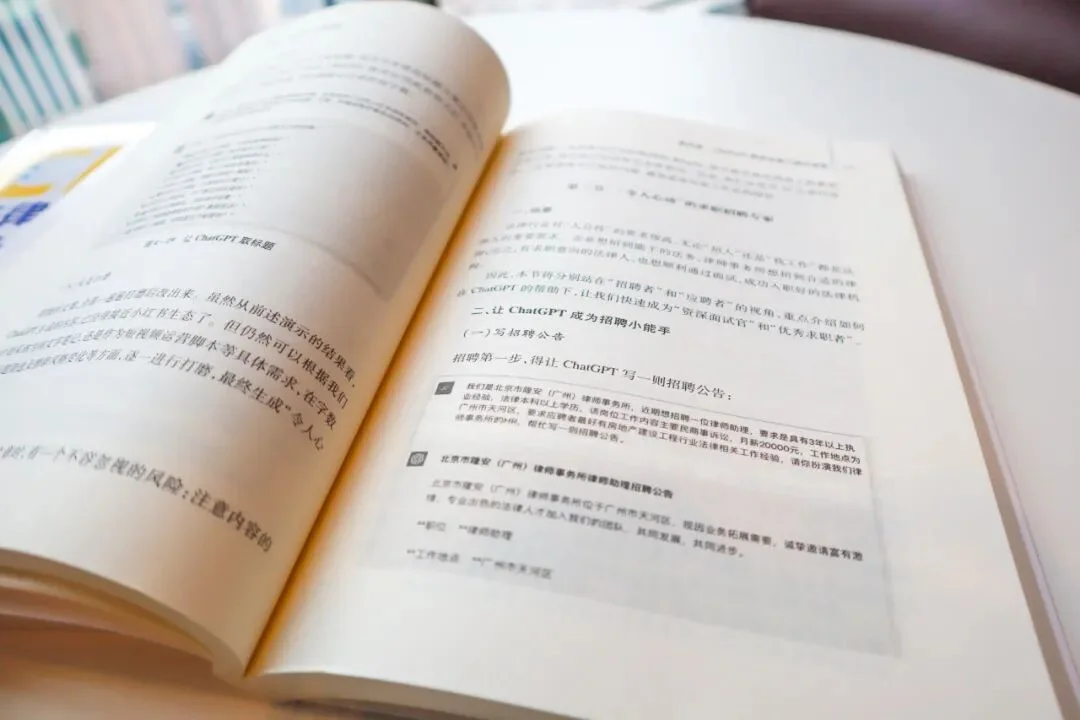

Excerpt from the excellent content of “Guide to the Application of ChatGPT for Legal Professionals”
In addition, the book shares many other excellent contents, and sincerely uses the method of “teaching you how to do tasks step by step” to enable readers to complete a task and gain a skill after reading each chapter, and on this basis, provide an “advanced” learning experience, further guiding readers to build a localized GPT and create their own private AI legal assistant, making AI tools better at understanding Chinese law.

Excerpt from the table of contents of “Guide to the Application of ChatGPT for Legal Professionals” (3)
In the AI era, what abilities should legal professionals develop more?
The legal knowledge that a law student learns in 4 years of university can be mastered by ChatGPT in less than a second. We can’t help but feel terrified: What advantages do legal professionals have in front of AI? Or rather, what abilities should legal professionals develop in the AI era? The author believes that at least the following 3 abilities are important:
1. Ability to cooperate with machines. As much as you know, so much does ChatGPT know. It is like a super intelligent assistant; you teach it anything, and it will only be better than you. Since some things machines do better than humans, let them do them. After the computer was invented, we hardly go to libraries to look up laws or write legal documents by hand, because information retrieval and digital office work have made these problems easy for us. This is still true today. AI is like a fast horse; we don’t need to race against it (compete), but should learn to ride it (cooperate).
2. Ability to make value judgments. On a small scale, one needs to have “aesthetic judgment ability.” ChatGPT and your assistant, they both know whether the documents they write are good or need improvement. On a larger scale, one needs to have the value orientation ability of a judge (or even a legislator). One needs to know what values are protected under the laws.
Speaking of this, we have to mention an experience of the author visiting a mall. The author wanted to deposit a umbrella, but the woman at the information desk refused. She pointed to the service board and said, “Sir, sorry, we have regulations and do not provide luggage storage services.” The author looked at the service board, which listed “lost items,” and immediately changed from a person who deposited luggage to a kind person who picks up lost items. He immediately said, “Oh, I got it wrong. This umbrella I just picked up. Please put it with the lost owner.” Finally, he successfully deposited the umbrella through the “lost items” service. This shows that using rules and making decisions is an important ability for legal professionals. In the Internet era, laws and regulations are public, legal knowledge is public, and judgment documents are also public. Everyone can easily have this information. Since AI is so powerful, why not input the case details into the machine and directly get the judgment result? Even with AI, society still needs legal professionals because machines cannot replace people in applying and evaluating rules. Humans are humans not because of their “intelligence,” but because of their “wisdom.” This wisdom gives us the ability to adjust social order through rules, which is the value orientation of human society.
3. Ability to empathize with clients. The judges and prosecutors that the author admires are not those with the best professional skills or the most honors, but definitely the ones that are most “people-centered.” Every time they handle major and difficult cases, we hope to encounter such judges and prosecutors, because they can penetrate the cold laws and make both parties and their representatives feel the warmth of justice, achieving a good legal and social effect of “both victory and defeat, and the case is resolved.” Similarly, the author has seen countless successful entrepreneurs’ lawyers, who are not the most famous or the most professional in a certain field, but the ones that clients trust the most. While providing professional value, legal professionals also provide emotional value. We handle cases, but also the lives of others. When legal professionals can provide empathy, which machines do not have, it not only deepens the trust of the parties in us, but also promotes the people to feel the warmth of fairness and justice in every judicial case.

Conclusion: It’s better to stay at home and plant trees than fear standing by the water’s edge
From the spinning loom, the steam engine to the generator, technology has promoted productivity while also eliminating workers from old production lines. Similarly, AI will replace some repetitive and mechanical jobs. Yes, AI will become stronger, and the speed of its strengthening will increase. It is very likely that legal professionals will think about the scenario of “being replaced by AI.”
But anxiety cannot solve problems; learning can overcome the fear of the unknown. To plant a tree, the best time is ten years ago, and then now. Therefore, in the face of new AI like ChatGPT, learning and using it first is more important than anything else.
After all, you need to understand that AI is a new era, not a cycle. If you miss the cycle, it will return, but the era eliminates a person without saying a word or turning back. There have been few innovations in history, and if you can grasp them, it is a benefit of the era. If you miss them, you can only lose your competitiveness.

How to purchase this book:
-
You can scan the QR code on the poster above to purchase directly;
-
Or click the purchase link:
https://item.m.jd.com/product/14377202.html#main
If you want to learn more about using ChatGPT, please add the author’s WeChat. When adding, please note: name + unit (https://img.longangz.com/shi-dai-fa-lv-ren-ru-he-bi-mian-bei-tao-tai/shi-dai-fa-lv-ren-ru-he-bi-mian-bei-tao-tai-4.webp)