
Recently, the third issue of 2024 of Guangdong Lawyer (Issue 242 in total) published an article written by Lawyer Li Dingbang, Deputy Director of the Marriage, Family and Wealth Management Department of Longan Guangzhou, and Deputy Director and Secretary-General of the Longan Bay Area Integrated Law, Finance and Tax Research Center. The article is titled “The Challenges and Solutions in Tax Administration after Company Closure from the Perspective of Civil and Commercial Law”. This is the second time that Lawyer Li Dingbang has published a relevant article in Guangdong Lawyer.
Guangdong Lawyer was founded on October 28, 1981. It is one of the earliest publications sponsored by provincial lawyer associations in China. Guangdong Lawyer is an excellent journal in the national lawyer industry. It is an authoritative platform for practicing lawyers in Guangdong to showcase their professional experience and theoretical achievements. It is also the only provincial-level journal in the lawyer industry of Guangdong Province.
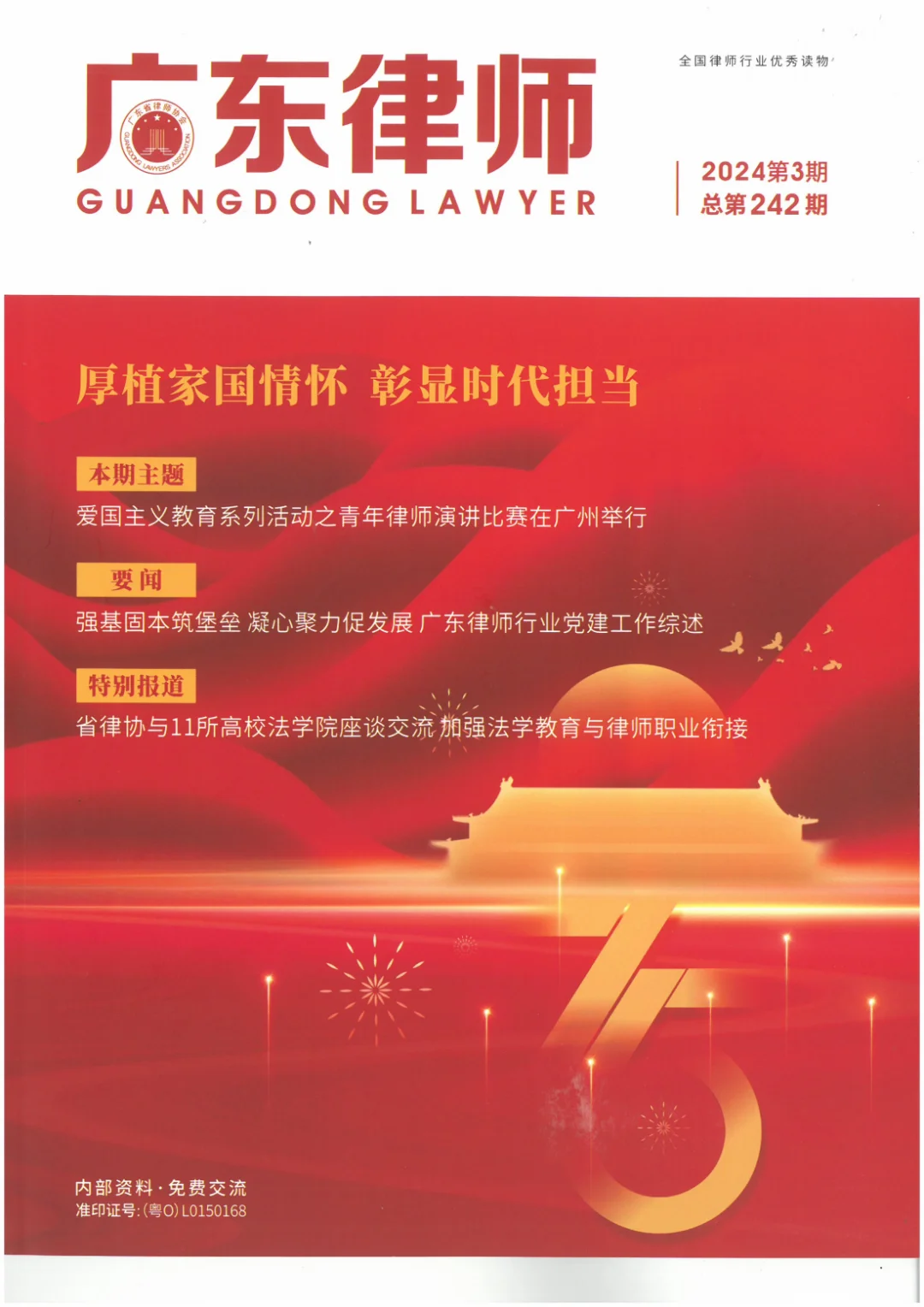
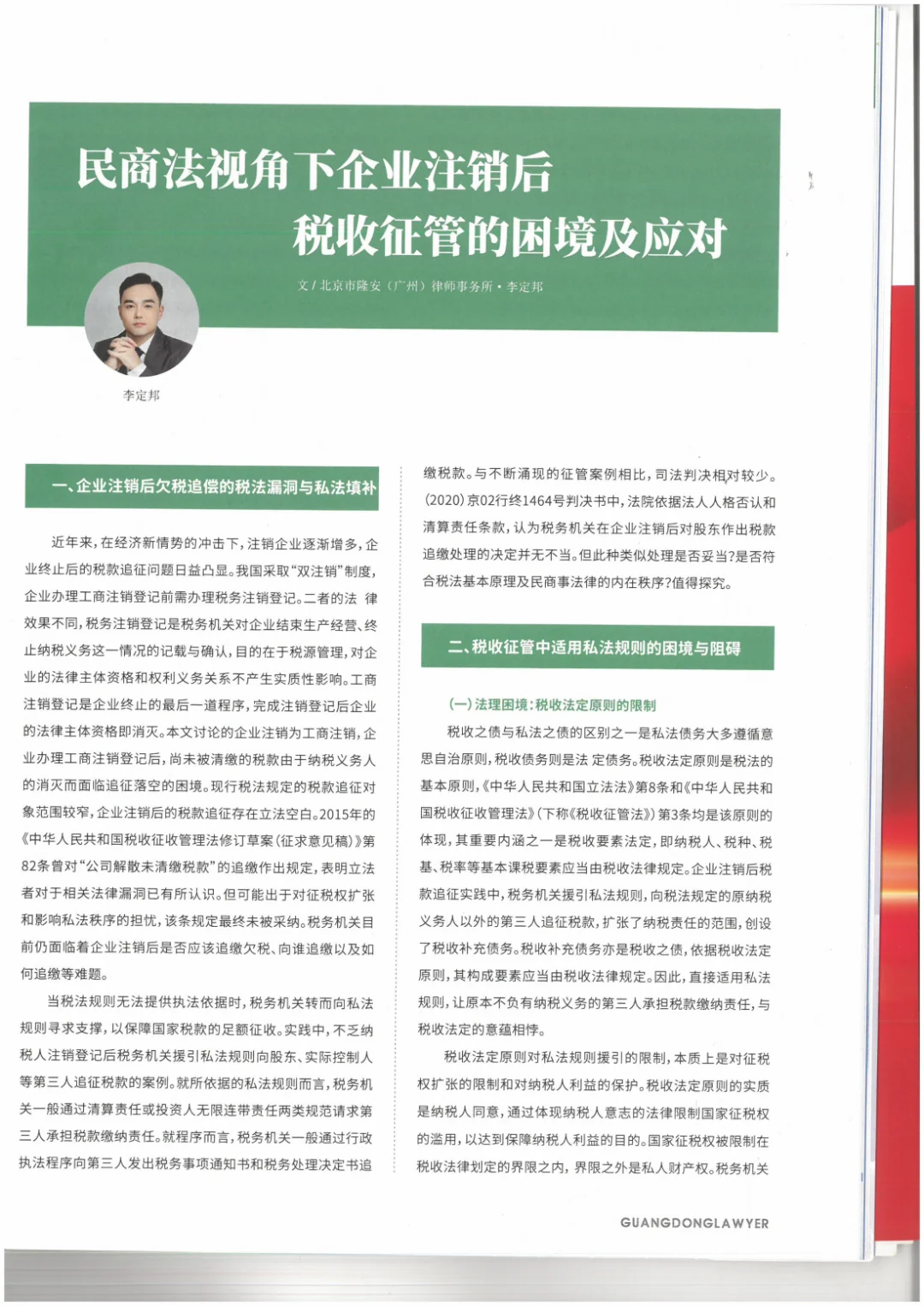
The inspiration for this article came from the cases handled by Lawyer Li in practice. After several rounds of systematic refinement, ideas were exchanged and perspectives were absorbed with top domestic accounting firms such as Tianzhi International and Guangdong Sinong. Finally, the article was completed. This article focuses on the difficulties in tax debts after company closure, identifies the underlying reasons for these challenges, and then explores feasible approaches to meet practical needs while balancing the interests of the state and taxpayers. Based on the current legal practice of tax debts, from the perspective of civil and commercial law, it suggests that tax authorities should abandon the administrative procedures dominated by public power and move into the private law domain. A strict and cautious administrative approach to revoking the cancellation registration should be adopted to collect taxes. Ultimately, under the principle of governing taxation according to law, the interests of the state in taxation and the rights of taxpayers can be protected both ways. This article has certain practical significance and has been highly recognized and affirmed by many cooperation units, associations, and chambers of commerce.
In the future, Longan Guangzhou lawyers will continue to work hard, deepen theoretical research, and strive to publish more high-quality and high-level professional articles. By promoting practical development through theory, they will provide clients with more professional and efficient legal services.
Profile of the Lawyer
 Lawyer Li Dingbang
Lawyer Li Dingbang is Deputy Director of the Marriage, Family and Wealth Management Department of Longan Guangzhou, Deputy Director and Secretary-General of the Longan Bay Area Integrated Law, Finance and Tax Research Center, Member of the Legislative Advisory Committee of the Standing Committee of Hainan Provincial People’s Congress, External tutor at the Law School of Guangdong University of Foreign Studies, Deputy Secretary-General of the Liwan Popular Music Association in Guangzhou, Permanent Director of the Guangzhou Public Welfare Financial Innovation and Development Center, and Member of the Academic Committee of the Chinese Will Library.
He graduated from China University of Political Science and Law with a master’s degree in civil and commercial law. He participated in the formulation of the general provisions and guarantee system interpretations of the Civil Code. He also studied at Columbia University Law School. He has received many awards at national civil and commercial law doctoral forum and Hubei Civil Law Research Association. He has published more than ten papers on law and united front work in academic and practical journals such as Tsinghua Law Review, Guangdong Lawyer, and Insurance Theory and Practice. He completed the second session of the Guangdong Guangdong-Hong Kong-Macao Greater Bay Area foreign-related lawyer training program. During this period, he won the “Outstanding Debater” award in the mock arbitration competition and the first prize in English document writing.